
A minor travel consent form is a letter signed by a parent or legal guardian giving a child permission to travel without one or both parents. An airline or border officer may ask for it, especially on an international trip.
Also called a child travel consent letter, it is commonly used when a child travels with one parent, grandparents, another adult, a group, or alone. Requirements depend on the destination and the child's circumstances.
Download our free form below. Choose the fillable PDF to type in the details, or print a blank copy to complete by hand.
- Free Child Travel Consent Form (fillable PDF) — Complete, print, and sign.
- Free Child Travel Consent Form (blank printable) — Print and fill out by hand.
See more information about when the form is required, notarization, unaccompanied minors and more.
Is it required? The United States does not require evidence of both parents' permission for a minor to travel internationally, but some other countries do. Check the entry and exit rules for every country on your itinerary. U.S. Department of State: Travel with Minors.
Check the form before using it: Our PDF refers to an accompanying adult "over 21" and contains medical-treatment language. It may not suit a child traveling alone or with a younger adult. Check the destination's rules and use its required form if there is one. Separate medical authorization may also be needed.
Table of Contents
- Why Carry a Child Travel Consent Letter?
- How to Fill Out the Form
- Download the PDF
- When Is a Consent Letter Required?
- Does the Letter Need Notarization?
- Children Flying Alone
- Other Documents and Travel Planning
- Additional Services
- Related Articles
Why Carry a Child Travel Consent Letter?
A U.S. passport identifies a child and establishes U.S. citizenship, but it doesn't prove that the adult traveling with the child has parental permission. A consent letter helps answer that question.
Airline staff or border officers may ask for the letter, other documents, or contact details for a parent who isn't traveling. Carrying the appropriate paperwork can help avoid delays.
When Should You Carry a Consent Letter?
Consider carrying a signed consent letter when a child is:
- Traveling with one parent: The child travels with one parent while the other stays home.
- Traveling with grandparents: Grandparents take a grandchild on a trip without the parents.
- Traveling without parents: The child travels with relatives, family friends, teachers, coaches, or another authorized chaperone.
- Divorced or separated parents: An accompanying parent may need to document consent or comply with a custody agreement.
- Sole legal custody: The parent may need a custody order or other proof of legal authority.
- Different last names: Birth certificates, adoption documents, or other records may help explain the relationship.
- Unaccompanied minors: Children traveling alone may need both parental authorization and airline-specific documents.
There is no universal form accepted by every country. Check State Department guidance and the destination's embassy or consulate before your trip.
What to Include in the Letter
A consent letter should identify the child, the accompanying adult, the trip, and the person giving permission. Include:
- The child's full legal name, date of birth, and passport information if applicable
- The accompanying adult's full name, relationship to the child, and identification details when appropriate
- Exact travel dates, destinations, and relevant itinerary information
- Names and reachable contact details of the non-traveling parents or legal guardians
- An explicit statement authorizing travel with the named adult or alone
- Signatures of the parents or guardians whose permission is required
- A notarial certificate or acknowledgment when required by the destination or travel provider
A travel consent letter does not automatically authorize a grandparent, coach, or other adult to make medical decisions. Check with your airline and destination(s) whether separate medical authorization is appropriate when a child travels without a parent.
Traveling with your child while the other parent stays home? Read our one-parent travel Q&A.
How to Fill Out the Minor Travel Consent Form
You can complete our minor travel consent form on a computer or fill out the printed copy by hand. Before signing, check whether your destination requires its own form or wording.
To complete the form:
- Download the form: Use the Minor Travel Consent Form (fillable PDF) or blank printable PDF.
- Complete the details: Enter the child's information, authorized adult, destinations, and exact dates.
- Identify the correct signers: Confirm which parents or guardians must grant consent and comply with any custody orders.
- Sign and notarize when appropriate: Follow the destination's requirements. If notarization is needed, ask the notary when and how to sign.
- Distribute the documents: Give the traveling adult the required originals and keep copies and digital backups. Officials may require the original signed letter.
The letter doesn't replace the child's passport, visa, or other entry documents. Need a passport quickly? See urgent child passport options.
Filling it out by hand? Print the blank PDF and write clearly in black ink.
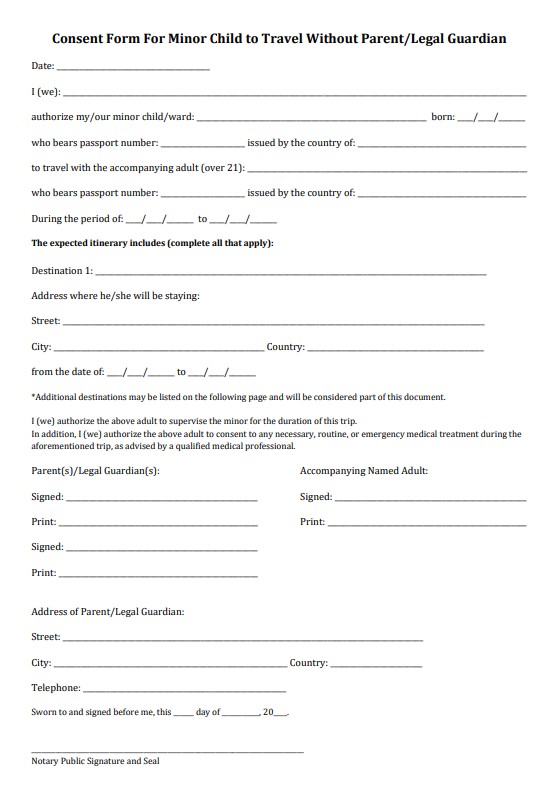
This is a sample permission letter, not a government form. It cannot override a court order or replace a destination-specific authorization.
Download the Consent Form
Related passport resources
Is a Minor Travel Consent Form Required?
Not every trip requires a consent letter. The rules depend on where the child is going, who is traveling with them, and any custody orders. A U.S. sample letter may not satisfy another country's requirements.
International travel rules
Some countries require a signed, notarized letter when a child travels with one parent, another adult, or alone. Others may ask for a birth certificate or proof of custody. See the State Department's guidance on travel with minors.
Check the rules for countries you visit or pass through. Our foreign entry requirements guide is a starting point; the destination's embassy or consulate can confirm which documents it accepts.
For specific situations, read our guides to grandparents traveling internationally with grandchildren and international travel with a child who has a different last name.
Example: Traveling to Canada with a Minor
For a child entering Canada with one parent, Canadian immigration guidance says to carry the child's passport, a copy of the birth certificate, and a letter from the non-traveling parent with contact details and a copy of that parent's signed passport or national ID. Different documentation applies to children traveling alone or with another adult. See Canada's entry guidance for minors.
Example: Travel Authorization Requirements in Brazil
Brazil requires exit authorization for Brazilian minors, including dual U.S.-Brazilian citizens, traveling without both parents. Depending on the situation, this may mean two original authorizations from each absent parent or an authorization annotation in the child's Brazilian passport. Brazilian authorities do not accept an English letter notarized by a U.S. notary in place of the required authorization. Read the State Department's Brazil rules before traveling.
Custody and Additional Documentation
Separated or divorced parents should review the custody order before traveling and carry the relevant documents when needed. A consent letter cannot override a court restriction. If permission is disputed, consult a qualified legal professional.
If the child's passport is expired or damaged close to departure, review our guide to an urgent passport for a minor.
What about domestic flights?
For domestic U.S. flights, TSA does not generally require identification from children under 18, and a travel consent letter is not normally part of security screening. Airlines can set their own rules for children, especially when they fly alone.
A written permission letter may still be useful when a child travels with another adult. Check the airline's policy and any applicable custody order.
Minor Travel Consent Form Notary Requirements
Does a minor travel consent form need to be notarized? Sometimes. A country or travel provider may require notarization, but not every trip does. A notary verifies the signer's identity and signature, not custody rights or acceptance by a foreign government.
How to Get a Minor Travel Consent Form Notarized
- Download and complete the fillable minor travel consent form PDF.
- Determine which parent or legal guardian must sign.
- Check whether the destination requires a special form, wording, translation, or method of notarization.
- Contact a commissioned notary public, such as one available through a bank, shipping center, or authorized online notary service.
- Bring acceptable identification and sign according to the notary's instructions.
- Make sure any required notarial certificate, date, signature, and seal are completed properly.
The notary block is the certificate the notary completes. Ask the notary to use the wording required for the type of notarization the destination accepts.
Can You Notarize a Minor Travel Consent Form Online?
Some U.S. states allow remote online notarization, but a foreign government may require an original paper document or a particular notary procedure. Confirm the rules before paying for online notarization.
NotaryLive offers online notarization. Check with the destination's embassy or consulate first to make sure remote notarization is acceptable.
Children Flying Alone
Airlines set their own minimum ages and rules for children flying alone. Some charge a fee for supervision, restrict connections, or require details for the adults dropping off and collecting the child.
A consent letter does not replace an airline's unaccompanied-minor paperwork. International trips may also require permission documents at the border.
- Confirm the airline's minimum age and supervision requirements.
- Ask whether airline-specific authorization forms are needed.
- Check passport, visa, and destination-country permission requirements.
- Provide emergency contacts and the details of adults seeing the child off and meeting the child.
For details, consult our guide to unaccompanied minors traveling internationally.
Other Documents and Travel Planning
Keep the child's passport, consent letter, itinerary, and other required documents in carry-on luggage, not in a checked bag.
If You Share Custody
If you share custody, check the terms of your court order before leaving the country and ask the destination's embassy about any additional permission requirements.
A brief permission statement could read:
"I, [PARENT NAME], authorize [ACCOMPANYING ADULT] to travel with my child, [CHILD'S FULL NAME], to [DESTINATION] from [START DATE] through [END DATE]. I can be reached at [PHONE NUMBER] to confirm this permission."
Parent or Legal Guardian Signature: ______________________ Date: ______________________
This is an example of the wording, not a replacement for a destination's required form. Our fillable PDF includes spaces for trip details and signatures.
Carry Additional Documents When Appropriate
- A child's birth certificate or adoption records, when relevant to the family's circumstances
- Relevant custody or court orders
- Documentation concerning a deceased parent, if applicable
- A separate medical authorization document for a non-parent caregiver, when appropriate
- Emergency contacts and a copy of the itinerary
Plan for Expenses
If your child is traveling without you, plan how they will pay for meals, transportation, and unexpected expenses.
A parent-controlled debit card can be one option. Check international fees and whether the card will work in the destination before relying on it.
Greenlight offers spending controls and parent-managed transfers. Confirm its international-use restrictions and fees directly with the provider.
If you use a card, make sure the child knows how to reach you if it is lost or declined. Carry a backup payment option when possible.
If You Use a Tracker
A Bluetooth tracker can help you locate luggage, backpacks, and other belongings during a trip, but it is not a substitute for adult supervision or a real-time GPS tracking device. Check compatibility and coverage before traveling internationally.
- Apple AirTag (2nd Generation) uses Apple's Find My network to help locate luggage and other belongings. Location updates depend on nearby compatible Apple devices, so AirTags are not intended for tracking children in real time. Available individually or as a four-pack.
- Pebblebee Clip 5 works with Apple Find My or Google's Find Hub, making it an option for iPhone and Android users. It clips onto backpacks, luggage, or other belongings and has a rechargeable battery rated for up to 12 months. Like AirTag, it relies on nearby compatible devices to report its location rather than continuous GPS tracking. It can use only one finding network at a time.
Additional Services
- NotaryLive — Remote notary service. Verify that your destination accepts online notarization.
- Greenlight — Parent-managed spending card. Check international-use restrictions and fees.
Before You Travel
Check the consent rules for each destination, complete the appropriate form, and pack any supporting documents. Our international travel checklist for families with children covers passports, entry requirements, and emergency contacts. For other situations involving minors, start with our international travel with children guide.
Related Guides
International travel with children: documents and planning
How to get a passport for a minor
Form DS-3053: Consent to Issue Passport to Minor (for a passport application, not travel permission)
U.S. Customs and Border Protection: Children Traveling Without Their Parents
Can one parent apply for minor child's passport?
Does father need consent to travel alone with minor child?

