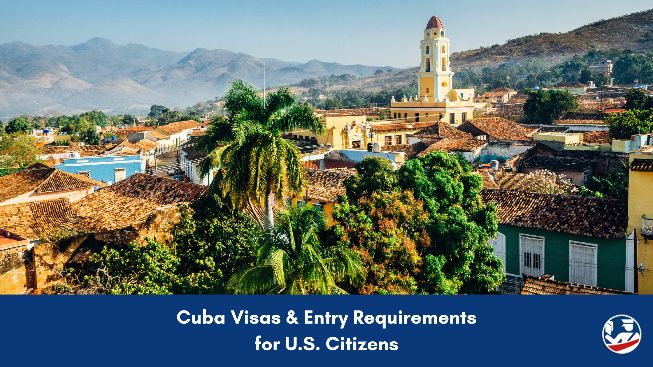
If you are planning a trip to Cuba, it is essential to understand that travel for "tourist activities" remains prohibited by U.S. law. However, most U.S. citizens can legally travel to Cuba by qualifying for one of 12 authorized categories of travel. As of July 1, 2025, Cuba has fully transitioned to a mandatory Electronic Visa (e-Visa) system, replacing the old paper "Tourist Cards."
This guide provides the simple facts you need to know about the 12 authorized travel categories, how to obtain your mandatory Cuba e-Visa (Tourist Card), and the essential steps to ensure your trip is compliant with both U.S. and Cuban regulations.
Official Application Portals: Because of strict U.S. regulations, third-party visa services cannot process Cuba travel documents for U.S. citizens. You must apply directly through the official Cuban government platforms.
On This Page
- Quick Summary: Cuba Entry Requirements
- U.S. Authorized Travel Categories
- U.S. Passport & Entry Requirements
- Health & Safety for Your Trip
- Additional Cuba Travel Rules & Requirements
- Cuba Visas & Entry FAQ
Quick Summary: Cuba Entry Requirements
| Feature | Details |
|---|---|
| U.S. Authorization | Must qualify for one of 12 OFAC categories (e.g., "Support for the Cuban People"). |
| Cuba e-Visa Fee | Approx. $50–$100 USD (Varies by airline or provider). |
| U.S. Passport Validity | Must be valid for at least 6 months beyond arrival. |
| Blank Passport Pages | At least 2 blank pages are required for entry/exit stamps. |
| Mandatory Forms | D'Viajeros digital form (must be completed within 7 days of arrival). |
| Medical Insurance | Mandatory (usually included in the cost of a U.S. airline ticket). |
U.S. Authorized Travel Categories
Under U.S. law (OFAC regulations), "tourism" is not a legal reason for U.S. citizens to visit Cuba. Instead, your reason for travel must fall under one of 12 authorized categories.
The most common category for individual travelers is "Support for the Cuban People." To satisfy the requirements for this category, travelers must maintain a full-time schedule of activities (designed independently) that directly support the Cuban people and local businesses, such as staying in private homes (casas particulares) and eating at private restaurants.
The 12 Authorized Categories include:
- Family visits
- Official business of the U.S. government, foreign governments, and certain intergovernmental organizations
- Journalistic activity
- Professional research and professional meetings
- Educational activities
- Religious activities
- Public performances, clinics, workshops, athletic and other competitions, and exhibitions
- Support for the Cuban people
- Humanitarian projects
- Activities of private foundations, research, or educational institutes
- Exportation, importation, or transmission of information or informational materials
- Certain authorized export transactions
U.S. Passport & Entry Requirements
Before booking your trip to Cuba, ensure you meet the legal requirements set by both the U.S. Department of the Treasury (OFAC) and the Cuban government.
U.S. Passport Validity
U.S. citizens must have a valid U.S. passport to enter Cuba. Passport validity must be at least 6 months beyond your arrival date. Your U.S. passport must also have at least two blank pages for entry and exit stamps.
Passport expiring soon? Don't let an expired passport or a lack of 6 months validity derail your trip. You can expedite your passport renewal online and get it fast.
Cuba e-Visa (Electronic Visa) Application
Effective July 2025, the digital Cuba e-Visa has permanently replaced the pink paper Tourist Cards. The visa allows a single entry for a stay of up to 90 days (extendable once for another 90 days). Once approved, your Cuba e-Visa is digitally linked to your U.S. passport, and you will receive a code that must be entered into your D'Viajeros Digital Declaration Form. The e-Visa fee is approximately $50–$100 USD, depending on your airline or provider.
Unlike many other international destinations, there are stringent regulations regarding travel between the United States and Cuba. Because of these restrictions, third-party visa services are not authorized to provide application support or processing for U.S. citizens. You must obtain your e-Visa directly through your airline or via the official Cuban government portal at evisacuba.cu.
D'Viajeros Digital Declaration Form
All travelers must complete the D'Viajeros Digital Declaration Form online within 7 days before arrival. This form combines your Health Declaration, Customs, and Immigration data. Once completed, you will receive a QR code that must be presented (digital or printed) to board your flight and to immigration officials upon arrival in Cuba.
Health & Safety for Your Trip
Mandatory Health Insurance
Cuba requires all foreign travelers to have non-U.S. medical insurance. For U.S. citizens flying directly from the United States, this insurance is almost always included in your ticket price (look for a surcharge labeled "Health Insurance" or "AC" on your receipt). Carry your boarding pass as proof of insurance while in Cuba.
Health Recommendations
According to the U.S. Centers for Disease Control and Prevention (CDC), travelers should ensure they are up-to-date on routine vaccines. Hepatitis A and Typhoid are recommended due to potential food or water contamination. A Yellow Fever vaccination certificate is required only if traveling from a country with risk of Yellow Fever transmission.
Note on Medication: There is a severe shortage of medicine in Cuba. You must bring all your own prescription medications, as well as over-the-counter essentials like pain relievers, anti-diarrheals, and a first-aid kit.
Additional Cuba Travel Rules & Requirements
Currency & Payments
U.S. credit and debit cards do not work in Cuba. You must bring enough cash (USD or Euros) to last your entire trip. While the Cuban Peso (CUP) is the official currency, and some government-run places use "MLC" (digital currency), most private businesses will only accept cash.
Prohibited Accommodations
U.S. travelers are prohibited from staying at certain hotels and properties controlled by the Cuban military. You must always check the Cuba Restricted List provided by the U.S. State Department before booking your accommodations.
Traveling with Minors
Minors must have their own valid U.S. passport book and e-Visa. If a minor is traveling with only one parent, a notarized Minor Travel Consent Form is highly recommended to prevent issues or delays at the border.
Dual Nationality
Cuba does not recognize dual citizenship for Cuban-born individuals. If you were born in Cuba, you must enter and depart using a valid Cuban passport, regardless of your U.S. citizenship status.
Cuba Visas & Entry FAQ
A: No. "Tourism" is prohibited. You must travel under one of 12 permitted categories.
A: No. Paper Tourist Cards (pink or green) were phased out on December 31, 2025. All foreign travelers are now required to have a digital Cuba e-Visa.
A: No. When you visit Cuba, you travel under a "General License," meaning you simply declare your category (e.g., Support for the Cuban People).
A: Yes. U.S. law requires you to keep receipts and a record of your activities for 5 years after your trip to prove you complied with your chosen travel category (as required by the U.S. Department of the Treasury's Office of Foreign Assets Control (OFAC)).
A: No. U.S.-based health insurance plans are not accepted in Cuba. You must use the mandatory Cuban medical insurance (usually provided by your airline). Bring your own prescriptions, over-the-counter medications, and a first-aid kit.