
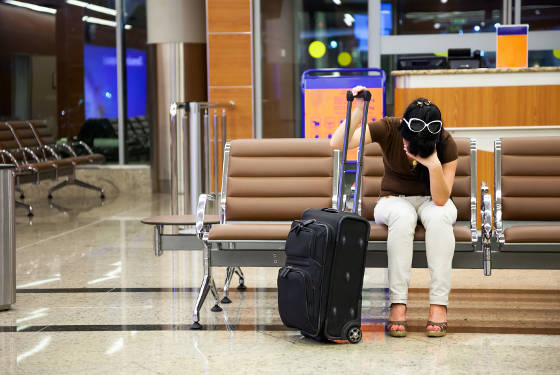
Grounded at airport by cookelma/DepositPhotos
Earlier this year United Airlines, Delta Airlines, and American
Airlines implemented new carry-on size limits for their passengers.
They have gone so far as to install baggage "sizers" at departure
gates; if your bag doesn't fit in the sizer, you can't bring it into
the cabin. The new maximum size limits, including wheels and handles,
are a 9-inch depth, by 14-inch width, by 22-inch length. What was once
an overall limitation of 45 inches, is now so specific that it
disallows many standard carry-ons that passengers have been using for
years.
 ,
which sells for $469, is 22 inches by 14 inches by 9 inches. Since the
9-inch dimension is often what excludes passengers' bags, this carry-on
is well within the restrictions.
The more moderately priced CalPak Silverlake 20" Expandable Lightweight Carry-On
sells for under $60. This bag's hard shell feature, which comes in a
variety of colors, ensures that your bag always meets the size
requirements, since it is not expandable and cannot be overstuffed. The
dimensions are 20 inches, by 13.5 inches, by 9.2 inches. Baggage sizers
add an inch to each dimension, so the hard body 9.2 depth will easily
fit every time.
Carry-ons are obviously not going to be out of sight and tossed around
by baggage handlers, so don't be afraid to look into less expensive
options. Discount retailers like TJMaxx have compliant carry-on
options. Bring your tape measure to make sure your new bag will be
compliant. For example, CIAO has a hard shell carry-on that meets the
size restrictions for $40. Even on Amazon, it is difficult to find size
compliant carry-ons for under $60, so discount retailers are a good
option.
The best advice for staying within the airlines' newly enforced size
restrictions is to think like a minimalist and become an organization
ninja. It takes skills and creativity to pack lighter and still fit
everything you need into a smaller bag. If you have trouble making the
tough decisions for what goes in the carry-on and what stays,
fortunately there are travelers who have packing down to a science and
they share their wisdom freely online.
John Lopinto from the Expert Flyer
suggests a neutral color palette in clothing for mix-and-match outfits
that cut down on the need for a new outfit each day, and limiting
shoes, remembering that you're wearing a pair. Stick with travel sized
liquids and keep in mind many hotels offer freebies; put them in a
quart-sized bag at the top of your carry-on. If you didn't go the safe
route and purchase a hard shell carry-on, don't overstuff your bag. He
suggests packing from the perimeter to the center and layering, big
items first, then filling in spaces with smaller items.
Louis Vuitton has a special section on their website called Art of Living.
You choose a bag size and everything to be packed is laid out,
surrounding the bag. Items highlight, you click on the highlighted
item, and it is virtually packed in the bag right before your eyes. You
see not only where to place things in the bag, but the order in which
to pack them. There are also tutorials for folding particular items
correctly. The whole pleasant packing experience is accompanied by
ambient music in the background, elevating your creative packing to a
new level of Zen.
Alex, at Travel Fashion Girl offers free packing e-books on her website; Capsule Wardrobe Essentials: How to Pack Light Using a 10 Piece Packing List and 10 Step Packing Guides. She has a link to Frugal First Class Travel that has several excellent packing lists including 'Real Life One Bag Travel: My Packing List." Alex also has a link to Ever in Transit, which features carry-on only, ready for any climate packing lists for men.
Besides showing you what to pack and how to pack it, she recommends
travel accessories and points you to the best places to shop. If all
that isn't enough, Alex is available to create a personalized packing
list for you depending on your purpose and destination. She asks that
you give her four weeks to do the research for the list.
Don't get your feelings hurt at the gate by trying to push the
boundaries of the newly enforced carry-on size rules. Pick a size
compliant carry-on and learn to make some packing adjustments to make
it work for you. It's better to be organized and regulation compliant
than having to repack and pay checked bag fees at the gate.
,
which sells for $469, is 22 inches by 14 inches by 9 inches. Since the
9-inch dimension is often what excludes passengers' bags, this carry-on
is well within the restrictions.
The more moderately priced CalPak Silverlake 20" Expandable Lightweight Carry-On
sells for under $60. This bag's hard shell feature, which comes in a
variety of colors, ensures that your bag always meets the size
requirements, since it is not expandable and cannot be overstuffed. The
dimensions are 20 inches, by 13.5 inches, by 9.2 inches. Baggage sizers
add an inch to each dimension, so the hard body 9.2 depth will easily
fit every time.
Carry-ons are obviously not going to be out of sight and tossed around
by baggage handlers, so don't be afraid to look into less expensive
options. Discount retailers like TJMaxx have compliant carry-on
options. Bring your tape measure to make sure your new bag will be
compliant. For example, CIAO has a hard shell carry-on that meets the
size restrictions for $40. Even on Amazon, it is difficult to find size
compliant carry-ons for under $60, so discount retailers are a good
option.
The best advice for staying within the airlines' newly enforced size
restrictions is to think like a minimalist and become an organization
ninja. It takes skills and creativity to pack lighter and still fit
everything you need into a smaller bag. If you have trouble making the
tough decisions for what goes in the carry-on and what stays,
fortunately there are travelers who have packing down to a science and
they share their wisdom freely online.
John Lopinto from the Expert Flyer
suggests a neutral color palette in clothing for mix-and-match outfits
that cut down on the need for a new outfit each day, and limiting
shoes, remembering that you're wearing a pair. Stick with travel sized
liquids and keep in mind many hotels offer freebies; put them in a
quart-sized bag at the top of your carry-on. If you didn't go the safe
route and purchase a hard shell carry-on, don't overstuff your bag. He
suggests packing from the perimeter to the center and layering, big
items first, then filling in spaces with smaller items.
Louis Vuitton has a special section on their website called Art of Living.
You choose a bag size and everything to be packed is laid out,
surrounding the bag. Items highlight, you click on the highlighted
item, and it is virtually packed in the bag right before your eyes. You
see not only where to place things in the bag, but the order in which
to pack them. There are also tutorials for folding particular items
correctly. The whole pleasant packing experience is accompanied by
ambient music in the background, elevating your creative packing to a
new level of Zen.
Alex, at Travel Fashion Girl offers free packing e-books on her website; Capsule Wardrobe Essentials: How to Pack Light Using a 10 Piece Packing List and 10 Step Packing Guides. She has a link to Frugal First Class Travel that has several excellent packing lists including 'Real Life One Bag Travel: My Packing List." Alex also has a link to Ever in Transit, which features carry-on only, ready for any climate packing lists for men.
Besides showing you what to pack and how to pack it, she recommends
travel accessories and points you to the best places to shop. If all
that isn't enough, Alex is available to create a personalized packing
list for you depending on your purpose and destination. She asks that
you give her four weeks to do the research for the list.
Don't get your feelings hurt at the gate by trying to push the
boundaries of the newly enforced carry-on size rules. Pick a size
compliant carry-on and learn to make some packing adjustments to make
it work for you. It's better to be organized and regulation compliant
than having to repack and pay checked bag fees at the gate.

